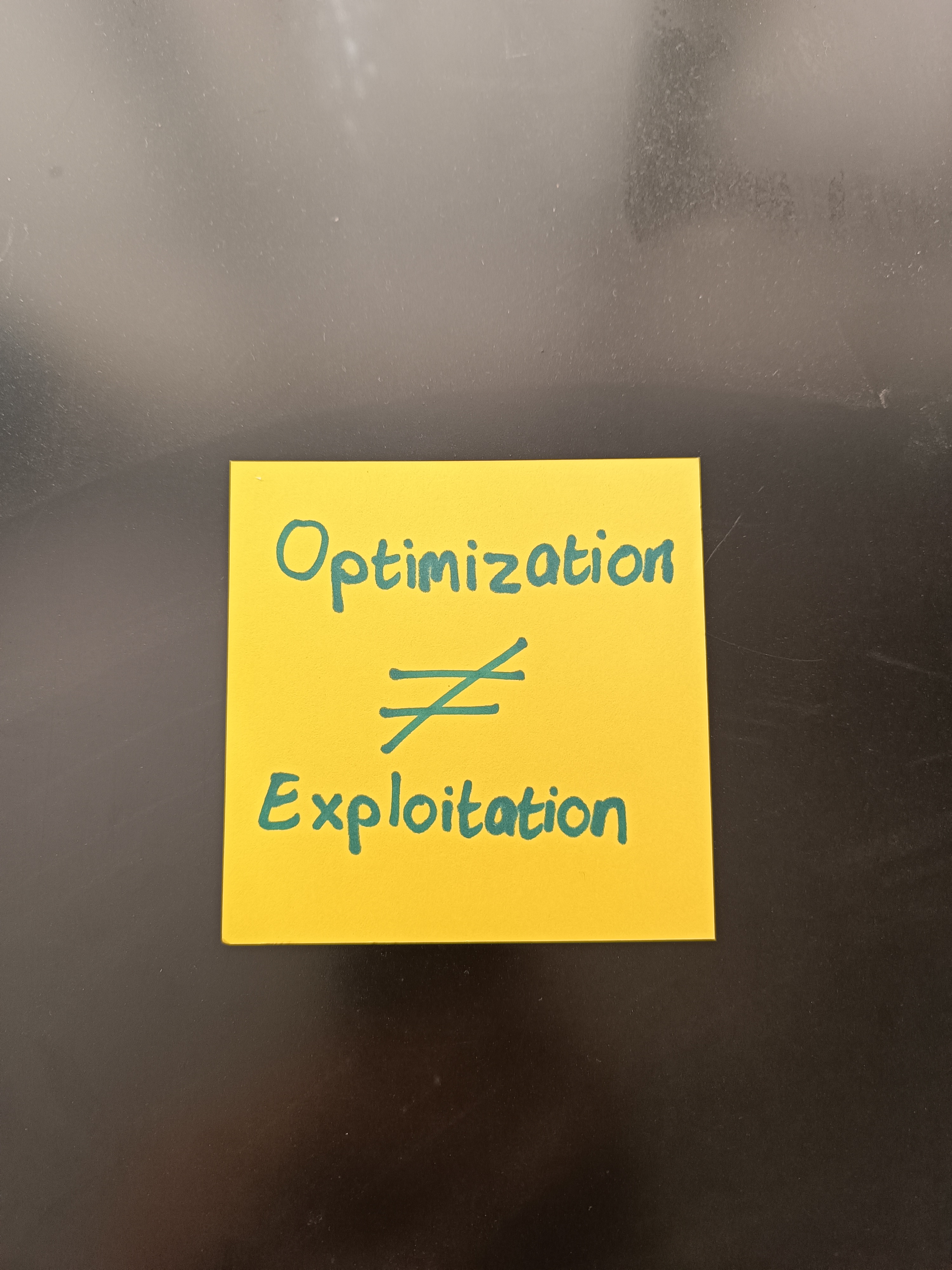

But a lot of people get this wrong...
Its is possible to optimise something and avoid the exploitation pitfalls?
In business, a task that can be performed efficiently can help us to work optimally. However, when an arbitrary goal is set to complete tasks more quickly, when it is not based on evidence or considering real-life experiences, it frequently results in employees being exploited.
The problem of inefficient task completion: For example, according your company's time management system, it indicates that the current task, that is usually allotted 60 minutes to perform, could be efficiently completed in just 45 minutes. This means that once the task is completed there should in theory be an extra 15 minutes. That extra 15 minutes can be used more optimally for other tasks. To adopt this new plan, to work more efficiently, you will need to communicate this method of optimization to the people who need to perform the task. The emphasis is communication which allows the opportunity for dialogue where the employees can provide feedback or alternatives.
Now, let us say that based on your latest business expense report you find that your expenses are going up while your profit margin is going down. Quite the opposite of a thriving business. One option is to consider all those ‘extra 15 minutes’ that could be gained every day and across the week. Mathematically, you might see that if you add them together there should be 3 hours more available to perform more tasks. So those 3 hours should be utilised to its maximum instead of ‘letting employees sit idle’.
You are faced with a decision:
1. Will you communicate with your team to work more efficiently to do more with the hours they have available? Along with having dialogue with your team to work more efficiently you explain to them that the business will also benefit, and your team might, as part of this dialogue, offer suggestions to make things even more efficient than you had considered.
2. Will you inform your team that from now on, the work they got streamlined at performing within 60 minutes, has to be performed within 45 minutes without exception; and that they will now have a revised target accordingly. Not a dialogue, but orders from management.
The problem of having employees with idle time: No company wants employees sitting with idle time. After all, an employee on a contract of 8 hours per day still has to be paid to sit there for those 8 hours. An employee with idle time is therefore literally costing your business money. So, it will do your business good to find out why there is idle time.
Now let's consider:
1. You can't (and shouldn't) punish those employees for idle time when its not their fault. Such as having office workers unable to work because of unexpected patchy internet in the office, or building repairs not being done because of torrential rain.
2. If the idle time is because sales are low, or the attraction of new customers is slow, then you should focus on finding the real cause. Not focus on the idle time. Why are sales low? What needs to be done to attract more customers?
3. Is the idle time a result of a work culture where the task has an allotted time for 'doing it right' as the work expectation? So much so, that somebody trained your employees strictly that "Task A will take 60 minutes, then task B will take 40 minutes, and eventually task C must take 25 minutes." As a result you have employees that are afraid of being punished for working faster than the allotted time just in case they are accused of not 'doing it right'.
4. Could it be that your employees are feeling unmotivated to the point where they would rather 'just do the job and be done', even if it means sitting idle for the rest of the day? The employees have no interest in helping the business do better. You need to ask why the employees are not feeling motivated? Is there an underlying cause for this lack of motivation that might be coming from management?
Optimization is not only about working more efficiently and avoiding idle time, but to simplify things we focus on them because these are concepts that most business owners are likely to consider. Unfortunately, the ideal of optimization is also a slippery slope where so many businesses aim for optimal work but it ultimately leads to employee Exploitation.
Exploitation is when employees find themselves at the receiving end of a toxic work culture.
The following is a non-exhaustive list of what that toxic situation can be like:
a) Management sets an arbitrary target that seems out of reach, and out of touch with reality.
b) Management offers no extension of work hours to reach the targets AND/OR no paid overtime to reach those targets.
c) Employees are faced with punishment if the targets are not met, such as not receiving bonuses.
d) Management imposes fear of further punishment, to the extent that the employees don't even take permitted lunch breaks or paid vacation days, just so that they can meet the targets.
e) Management sets up additional traps to trip up the employees, where even if the employee meets the target it is still not sufficient, because they didn't do it the 'correct way'.
f) Management threatens the employees with retrenchments / lay-offs as a result of the business suffering, placing the blame unfairly on the employees.
g) There is a refusal by management to hire additional employees to take up the workload and make it more reasonable for the employees to meet the targets.
h) Management with-holds annual salary increases AND/OR reduces other employee benefits.
Should you as an employer do any of the the above toxic things if you want your employees to work more optimally? NO! If you do these things, your are exploiting your employees, and placing them in a toxic work environment. DO NOT DO THIS!
How do you make people work faster and smarter (more optimally)? Is it possible to get your team to work optimally without falling into the trap of exploiting them?
When it comes to setting targets, don't just 'pick a number' arbitrarily, even if it seems logical based on the finances. There may be more 'to it' than you realise. You need to get employee engagement to find out why the tasks take the time they do. It also takes time to find out what can be done to perform those tasks more efficiently. Invest in what is required to become more optimized. What could that investment look like: getting more up-to-date software; providing refresher training; update the manual with 'best practices' on how to perform the task efficiently and correctly; do what is required to improve the employee experience; do what is required to attract and retain satisfied customers; etc.
The answer is: You can't make people work more optimally! Drop that mindset! That leads directly to employee exploitation and a toxic work culture. Instead you can work with addressing the issues that hinder employees from working efficiently, and work with your employees to improve the situation.
Tips that you can use to help boost employee morale for optimization:
You can provide incentives for performance that is 'over and above' a standard of excellence (but ensure to communicate the T's & C's up-front).
You can also provide a platform for your employees to present new ideas (their ideas may need to be 'fine-tuned', but ultimately give credit and possibly a financial reward where it is due to the specific employee who presented the idea).
You can gauge the interest of employees to find out who will be willing to take on different tasks, instead of their current tasks, to prevent monotony and complacency.